
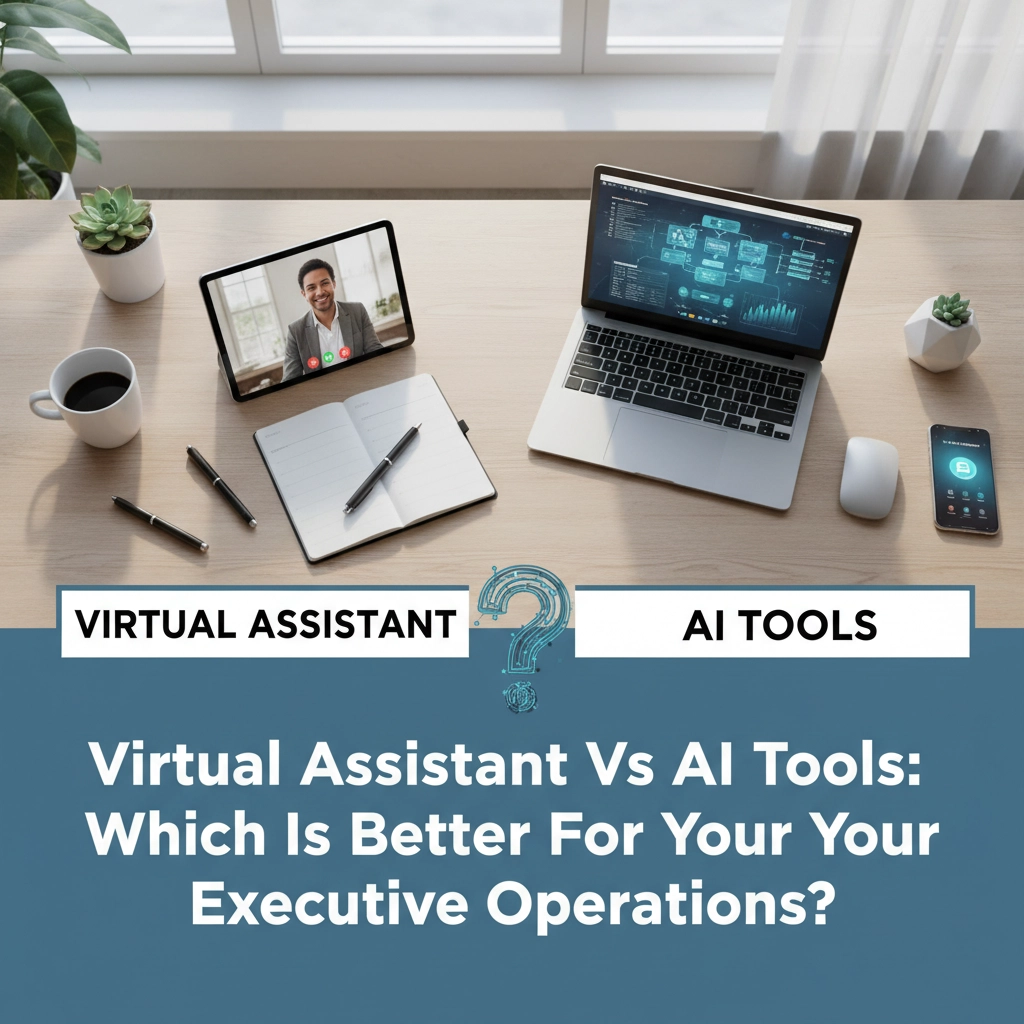
Virtual Assistant Vs AI Tools: Which Is Better For Your Executive Operations?
You're drowning in admin tasks, your inbox is a battlefield, and you're spending more time managing operations than actually running your business. Sound familiar?
Every high-performing executive faces this crossroads: hire a virtual assistant or lean into AI tools to handle the operational chaos. Both promise to free up your time, but they're completely different weapons in your productivity arsenal.
Here's the tactical breakdown you need to make the right call for your specific situation.
Understanding the Operational Battlefield
Before we dive into capabilities, let's be clear about what we're solving for. Executive operations aren't just about getting tasks done: they're about maintaining the quality, relationships, and strategic thinking that keep your business moving forward while you focus on what actually drives revenue.
The stakes are high. Choose wrong, and you'll either overpay for capabilities you don't need or underestimate the complexity of what you're trying to automate.
Virtual Assistant: The Human Advantage
Virtual assistants bring something AI can't replicate: adaptability and accountability. When your priorities shift mid-week (and they always do), a skilled VA pivots instantly without requiring system updates or retraining.
Core Strengths:
- Relationship intelligence: VAs build genuine connections with your clients, vendors, and team members
- Strategic thinking: They can read between the lines and make judgment calls that protect your interests
- Complex problem-solving: When something doesn't fit the standard playbook, human creativity kicks in
- Accountability: Someone owns the outcome and can be held responsible for results

VAs excel at nuanced communication: the kind that happens when you need someone to handle a delicate client situation or navigate a vendor negotiation. They understand context, read emotional cues, and adjust their approach based on what's actually happening, not just what the script says.
The downside? They're human. That means limited capacity, potential for inconsistency, and higher costs for high-volume, repetitive work.
AI Tools: The Automation Powerhouse
AI has evolved far beyond basic chatbots. Today's AI tools can handle complex workflows, maintain context across conversations, and deliver consistent results at scale that would exhaust any human assistant.
Core Strengths:
- Unlimited scalability: Handle 500 emails or 5,000 with the same accuracy
- 24/7 availability: No time zones, no sick days, no vacation requests
- Cost efficiency: Up to 80% more cost-effective for routine, high-volume tasks
- Perfect consistency: Every interaction follows the same quality standards
AI shines with structured, rule-based work: email sorting and responses, calendar management, data entry, report generation, and customer service for common inquiries. It processes information faster than any human and doesn't get tired or make careless mistakes on repetitive tasks.
The limitation? AI can't think outside its programming. When something unexpected happens or requires genuine creativity, you're stuck until someone updates the system.
Head-to-Head: Where Each Wins
| Capability | Virtual Assistant | AI Tools |
|---|---|---|
| Handling ambiguous requests | Instantly adapts and clarifies | Needs clear, structured inputs |
| Client relationship management | Builds trust and rapport | Purely transactional |
| Cost for high-volume tasks | Expensive and time-consuming | Highly cost-effective |
| Response to urgent changes | Immediate pivot capability | Requires system updates |
| Quality on routine work | Good but variable | Near-perfect consistency |
| Strategic decision-making | Strong judgment calls | Limited to programmed rules |
When to Deploy Virtual Assistants
Choose a VA when the work involves high stakes, complex relationships, or strategic thinking. Specifically:
Revenue-impacting activities: Client communications, sales support, business development, or anything that directly affects your bottom line needs human oversight.
Relationship management: When you need someone to build genuine connections with clients, vendors, or team members, human emotional intelligence is irreplaceable.
Complex project coordination: Managing moving parts across multiple stakeholders requires adaptability and creative problem-solving that AI can't match.
High-risk scenarios: Compliance issues, legal communications, or reputation-sensitive tasks need someone who can own the outcome.
If you're looking to streamline these kinds of strategic operations, Mission: Possible Organizing specializes in tactical virtual assistant services designed for executives who need more than basic admin support.

When to Deploy AI Tools
AI tools are your weapon of choice for high-volume, predictable work that follows clear rules:
Email management: Sorting, categorizing, and responding to routine inquiries at scale Data processing: Report generation, database management, and information analysis Scheduling: Calendar coordination for standard meetings and appointments Customer service: Handling common questions with consistent, accurate responses
AI becomes especially valuable when you're processing more than 50+ similar tasks daily or need 24/7 coverage without human limitations.
The Tactical Advantage: Combining Both
Here's where most executives get it wrong: they think it's an either/or decision. The most effective approach uses both strategically.
Deploy AI to handle the high-volume, routine tasks that bog down your operations. Use this to free up your VA's capacity for the strategic, relationship-driven work that actually moves your business forward.
For example: AI handles email sorting and initial responses, while your VA manages complex client communications and strategic follow-ups. AI processes routine scheduling, while your VA coordinates high-stakes meetings and manages conflicting priorities.
This hybrid approach maximizes ROI by putting each tool where it delivers the most value while minimizing the risks of full automation.
Your Action Plan
Step 1: Audit your current operational tasks. Categorize them as either routine/predictable or complex/strategic.
Step 2: Calculate the volume and frequency of routine tasks. If you're handling 50+ similar items daily, AI tools will deliver immediate ROI.
Step 3: Identify high-risk, relationship-sensitive, or revenue-impacting activities. These need human oversight.
Step 4: Start with AI for clear wins (email sorting, basic scheduling, data entry) to free up budget and capacity.
Step 5: Deploy a skilled VA for strategic work that requires judgment, creativity, and relationship management.
The key insight? This isn't about replacing human intelligence with artificial intelligence: it's about deploying each where they create the most value while protecting what matters most to your business.
Your executive operations deserve better than a one-size-fits-all approach. Choose your tools tactically, and you'll build an operational system that scales with your ambitions instead of holding them back.