Agent Intel HQ
MISSION BRIEF
Every elite agent needs a strategy. Each briefing equips you with tactical insight to complete your next mission
Real intel. Tactical strategies. Covert tips to help you organize, optimize, and dominate the chaos.
Stay informed. Stay equipped. Stay sharp.
Stay informed. Stay equipped. Stay sharp.

The Ski Slope Method: From Avalanche to Flow in Your Inbox, Systems, and Sanity
By Shana English, Virtual Executive Administrative Assistant & Professional Organizer
Ever feel like you’re standing at the top of a double-black-diamond to-do list, looking down at an avalanche of unread emails, overdue tasks, and business clutter?
You’re not alone.
Whether it’s an inbox bursting at the seams, a desktop that looks like digital Jenga, or a workflow that’s all “wing it” and no system—it’s easy to feel frozen. And that’s exactly why I use what I call the Ski Slope Method for tackling overwhelm in business.
It’s not just a metaphor. It’s a mindset—and one that’s deeply personal to me.
Virtual Assistant Vs AI Tools: Which Is Better For Your Executive Operations?
By Shana English, Virtual Executive Administrative Assistant & Professional Organizer
You’re drowning in admin tasks, your inbox is a battlefield, and you’re spending more time managing operations than actually running your business.
Sound familiar?
Every high-performing executive faces this crossroads: hire a virtual assistant or lean into AI tools to handle the operational chaos. Both promise to free up your time, but they’re completely different weapons in your productivity arsenal.
Here’s the tactical breakdown you need to make the right call for your specific situation.
7 Mistakes You're Making with Digital Organization (and How to Fix Them Like a Tactical Pro)
By Shana English, Virtual Executive Administrative Assistant & Professional Organizer
Your digital life is a battlefield, and right now, you’re losing.
Every day, executives and high-performers waste precious mental bandwidth searching for files, scrolling through chaotic inboxes, and drowning in digital debris.
The enemy? Poor digital organization habits that sabotage your efficiency and steal your focus.
But here’s the thing: you don’t have to accept digital defeat. With the right tactical approach, you can transform your digital chaos into a precision-engineered system that works for you, not against you.
Let’s identify the seven critical mistakes that are undermining your digital operations and the proven strategies to eliminate them once and for all.

The Ultimate Guide to Digital Transformation for Executives: Everything You Need to Succeed Without the Chaos
By Shana English, Virtual Executive Administrative Assistant & Professional Organizer
You’ve heard it a million times: “Digital transformation is essential for staying competitive.” But here’s what nobody tells you: 70% of digital transformations fail, and it’s not because of bad technology
It’s because executives treat it like an IT project instead of what it really is: a complete reimagining of how your business operates.
If you’re tired of watching competitors leapfrog past you while your organization drowns in outdated processes and disconnected systems, this guide is your roadmap to transformation success. No chaos, no overwhelm: just a clear path forward.

Operation Black File Secrets Revealed: What High-Level Executives Really Need in Confidential Admin Support
By Shana English, Virtual Executive Administrative Assistant & Professional Organizer
Let’s talk about something most executives won’t say out loud: you need someone who can handle the stuff that never makes it to the team meeting agenda.
The sensitive HR situation. The confidential contract negotiations. The personal financial documents that somehow always end up mixed with business files. The “this-stays-between-us” calendar items that require serious discretion.
That’s where Operation Black File comes in, and no, it’s not some shadowy government program. It’s what I call the elite tier of admin support that high-level executives actually need but rarely talk about openly.

Focus Among the Furry, the Tiny, and the Messy: Real-Life Strategies for Remote Work Success
By Shana English, Virtual Executive Administrative Assistant & Professional Organizer
Picture this: You’re deep in concentration, crafting an important email to a client, when suddenly a 90-pound Great Pyrenees mix decides your lap is the perfect spot for an impromptu nap. Meanwhile, two cats have claimed your desk as their personal kingdom, one draped across your keyboard and the other batting at your pen. Your phone buzzes with a Slack notification just as your Belgian Malinois starts barking at the mailman, and you realize you forgot to start dinner again.
If this scenario sounds familiar, welcome to the beautifully chaotic world of remote work with a full household. You’re not alone, and more importantly, you’re not failing. You’re just navigating a reality that most productivity gurus never mention in their perfectly curated advice.

Why Your Business Backend Is Costing You More Than You Think (And How to Fix It)
By Shana English, Virtual Executive Administrative Assistant & Professional Organizer
If someone asked you how much your inbox chaos costs you each year, what would you say? Most founders laugh it off. Some guess a few hours a week. But when you actually run the numbers, the answer is jaw-dropping.
Here is the reality: research consistently shows that knowledge workers spend an average of 28% of their workweek managing email alone. For a founder billing at even $150/hour, that is over $21,000 per year — lost. Not to a bad hire. Not to a failed ad campaign. To an unmanaged inbox.
And that is just email.
🎯 The Real Question
What would happen to your revenue if you reclaimed just 10 hours every week? For most founders, that is not a dream — it is the direct result of fixing your backend systems.
The MPO Protocol: A 3-Step System for Reclaiming Your Time as a Founder or Executive
By Shana English, Virtual Executive Administrative Assistant & Professional Organizer
Most productivity advice treats the symptom, not the disease. Use this app. Try this morning routine. Follow this email hack.
And it works — for about two weeks. Then the chaos creeps back in, because the underlying operational infrastructure was never fixed.
At Mission: Possible Organizing, we have worked with enough founders and executives to know one universal truth: sustainable productivity is not a mindset. It is a system. Specifically, it is three systems working together — and we call the framework the MPO Protocol.
🎯 What Is the MPO Protocol?
The MPO Protocol is a three-phase operational methodology used by Mission: Possible Organizing with every client: RECON, STRATEGIZE, and EXECUTE. It is designed to identify exactly where your business is losing time, build systems to stop the bleeding, and deploy ongoing support to keep operations running at peak efficiency.

Virtual Executive Assistant vs. Hiring In-House: What Founders Actually Need to Know in 2026
By Shana English, Virtual Executive Administrative Assistant & Professional Organizer
The question Every Growing Founder Eventually Faces
Your business has grown past the point where you can do everything yourself. Emails are piling up. Your calendar is a disaster. Important tasks are slipping through the cracks.
You know you need help. The question is: what kind?
For most founders, the debate eventually comes down to this: hire a full-time in-house executive assistant, or bring in a virtual executive assistant (VEA)? Both can be transformative. But they serve very different operational needs — and choosing the wrong option can cost you significantly more than you planned.
Let us break it down with full transparency, because this is a decision that deserves clear data, not sales copy.

5 Signs Your Business Needs Operational Backup Right Now (And What To Do About Each One)
By Shana English, Virtual Executive Administrative Assistant & Professional Organizer
Most Founders Wait Too Long
By the time most founders reach out for operational support, they have been living with the symptoms for months — sometimes years. The inbox pile-up that started manageable. The processes that were always going to get documented ‘next quarter.’ The calendar that somehow got away from them.
Here is the thing about operational debt: it compounds. Every week you operate without systems costs you more time and energy than the week before. And by the time it feels truly urgent, you are already deep in the hole.
We created this guide to help you recognize the signs earlier — so you can take action before the chaos becomes a crisis.
Outgrowing Your Own Systems: How to Scale Operations Without Breaking Your Business
By Shana English, Virtual Executive Administrative Assistant & Professional Organizer
The Growth Paradox Nobody Warns You About
Growth is supposed to feel like winning. More clients. More revenue. More momentum. So why does it so often feel like drowning instead?
Here is the paradox almost no one talks about: the exact systems that got your business off the ground are usually the same systems that start to collapse once that growth actually arrives. The spreadsheet that worked fine for 10 clients breaks at 50. The ‘I’ll just remember it’ approach that worked when you were a team of one becomes a liability the moment you hire your third employee.
Growth does not just add more of the same work. It multiplies complexity. And most founders find out their systems could not handle that multiplication at the worst possible moment — mid-launch, mid-hire, or mid-client-onboarding.
🎯 The Real Question It is not whether your business is growing. It is whether your operations can grow with it. Revenue growth without operational scalability is not success — it is a countdown. |

Systems Check: When to Scale, Simplify, or Start Over
By Shana English, Virtual Executive Administrative Assistant & Professional Organizer
The Problem With “Set It and Forget It” Systems
Every founder eventually builds a system that works. A client intake process. A project tracker. An invoicing rhythm. And because it works, it gets left alone — sometimes for years.
The trouble is that a system built for a five-client business doesn’t automatically hold up at fifteen clients, and a workflow designed for a solo founder doesn’t automatically translate once a team is involved. Systems don’t fail loudly. They fail quietly, in the form of missed follow-ups, duplicated work, and a founder who can’t explain why a simple task now takes three times as long as it used to.
🎯 The Real Question
It is not whether a system still runs. It is whether it still fits the business running it. A system that technically works can still be quietly costing you hours every week.

Reclaiming the Calendar: Time-Blocking Tactics for Founders Who Can't Say No
By Shana English, Virtual Executive Administrative Assistant & Professional Organizer
Why Your Calendar Is Lying to You
Most founders’ calendars describe an intention, not a reality. There’s a block for “strategic planning” that hasn’t happened in three weeks, and a meeting that was supposed to take thirty minutes but never does.
That gap between the calendar and the day isn’t a discipline problem. It’s usually a sign the calendar was built around an idealized schedule instead of the actual rhythm of the business — one that includes interruptions, last-minute requests, and a founder who has a hard time saying no.
🎯 The Real Question It is not whether your calendar looks organized. It is whether it reflects what actually happened last week — and whether the most important work survived contact with the rest of your day. |
The Retention Playbook: Turning First Impressions Into Long-Term Partnerships
By Shana English, Virtual Executive Administrative Assistant & Professional Organizer
Onboarding Sets the Ceiling, Not Just the Floor
A polished onboarding experience is often treated as the finish line, when it’s really the starting point. Onboarding tells a new client what working together will feel like — but it doesn’t guarantee that feeling continues once the initial excitement wears off.
The businesses with the strongest retention treat onboarding as the first data point in a much longer relationship, not the final deliverable of the sales process.
🎯 The Real Question
It is not whether your onboarding impresses a new client. It is whether the experience you promised in week one is still true in month six.
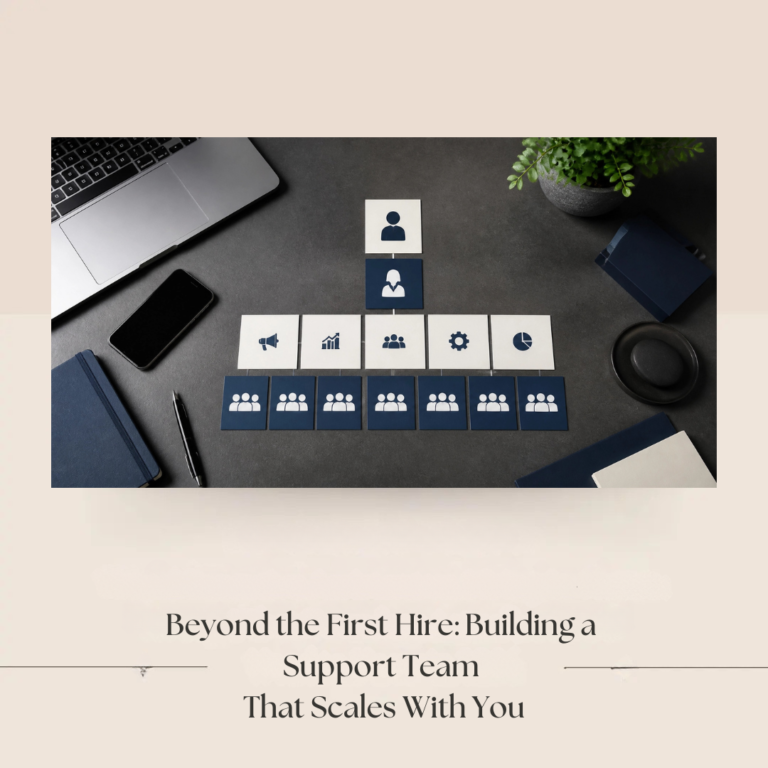
Beyond the First Hire: Building a Support Team That Scales With You
By Shana English, Virtual Executive Administrative Assistant & Professional Organizer
The First Hire Solves One Problem. Growth Creates New Ones.
A founder’s first hire is usually built around relief — getting one specific set of tasks off the founder’s plate. That hire often works well for exactly the problem it was built to solve, which is precisely why it’s easy to lean on that same role well past the point it can reasonably cover.
Growth introduces new categories of work — client communication, project coordination, content, finance — that a single generalist role was never designed to absorb all at once.
🎯 The Real Question It is not whether your first hire is good at their job. It is whether one role can still reasonably hold everything that’s been added to it since the day they started. |

Why September Is the Real Planning Month for Founders
By Shana English, Virtual Executive Administrative Assistant & Professional Organizer
January Gets the Credit. September Does the Work.
Every founder knows the ritual: December ends, resolutions get written, and January becomes the month everyone promises to “finally get organized.” But by the time January rolls around, you’re already behind. Q4 has come and gone, the holidays have eaten your bandwidth, and whatever systems were cracking in September are now fully broken.
September is the quieter, less glamorous planning month — and it’s the one that actually moves the needle. You still have a full quarter ahead of you. Enough time to fix a broken process, hire the support you’ve been putting off, or renegotiate a client relationship that’s draining more than it’s paying.
🎯 The Real Question
It is not whether you’ll eventually get around to planning. It is whether you do it while you still have a full quarter to act on it — or wait until Q4 has already made the decision for you.

Delegation Without Guilt: Letting Go of Tasks You Could Still Do Yourself
By Shana English, Virtual Executive Administrative Assistant & Professional Organizer
The Real Reason Delegation Feels Hard
It’s rarely a trust problem. It’s a competence problem — in reverse. You’re good at your business. You can write the email, format the invoice, answer the DM. The task isn’t hard for you, so handing it off feels like admitting you don’t need to be the one doing it. That feeling is exactly the signal to hand it off.
🎯 The Real Question
It is not whether you could still do the task yourself. It is whether doing it yourself is still the best use of the one thing no one else can replace — your judgment, relationships, or vision for the business.

Do You Actually Need More Support? A Founder's Framework for Scaling Sustainably
By Shana English, Virtual Executive Administrative Assistant & Professional Organizer
Overwhelm Is a Bad Hiring Signal
Most founders decide to hire the moment they feel maxed out — which means they’re often hiring in a panic, for the wrong role, to fix a symptom rather than a cause. Feeling overwhelmed tells you something is wrong. It doesn’t tell you what, or who fixes it.
🎯 The Real Question
It is not whether you feel overwhelmed. It is whether the cost of your own time on low-value tasks has quietly outgrown the cost of paying someone else to do them.

From Founder-Led to Team-Led: Building Systems That Outlast You
By Shana English, Virtual Executive Administrative Assistant & Professional Organizer
Every Business Starts Founder-Led. Not Every Business Should Stay That Way.
In the beginning, being the bottleneck is the job — you’re the only one who can be. But a business that still routes every decision through you at year three or year five isn’t founder-led anymore. It’s founder-limited. Revenue, client capacity, and team growth all cap out at whatever you personally have bandwidth for.
🎯 The Real Question
It is not whether your team is capable. It is whether your business can still function on a day you’re unreachable — or whether every important decision is still quietly waiting on you.
Inbox Triage for Founders: A 4-Step System to Take Back Your Q4
By Shana English, Virtual Executive Administrative Assistant & Professional Organizer
Q4 has a way of turning an inbox into a second job. Client questions, vendor follow-ups, year-end requests, and holiday scheduling all arrive in the same place, at the same volume, with the same urgency flag. When everything looks urgent, nothing gets prioritized, and your day gets set by whoever emailed last.
This is the gap between having an inbox and having an inbox system. The good news is that a system does not need to be complicated. It needs to be simple enough that you will actually use it when you are busy.
🎯 The Real Question
Is my inbox helping me run the business, or is it running me?